
Skip to content

Clinical data automation

From Protocol to Submission.

Clinical data automation built for the real-world complexity of clinical trials.

AI assists. Deterministic systems execute. Humans approve. Everything is traceable.

FlashEDC

Protocol → EDC & Data Capture

01

Protocol

02

Study Build

03

Data Capture

FlashAnalysis

Clinical Data → Analysis → Submission

04

SDTM

05

ADaM

06

Analysis

07

QC

08

Submission

The problem

Clinical trials still depend on enormous amounts of manual data work.

Between an approved protocol and a submission sits a large body of translation work. It is high-volume, high-consequence, and repeated for every study.

Protocol interpretation

Study teams read the protocol by hand and translate its intent into a design that can be built.

EDC study construction

Visits, forms, fields, controls, and code lists are assembled manually in the EDC environment.

Edit-check specification and programming

Checks are written as specifications, then implemented again as code in the EDC environment.

Data standards transformation

Collected data is mapped into SDTM and ADaM by programming that has to be maintained study after study.

Statistical programming

Tables, listings, and figures are produced by hand-written programs, each with its own derivations.

Quality control

QC is a second full effort, and its value depends on it being genuinely independent of the first.

Reconciliation

CRO and vendor deliverables are compared against sponsor outputs largely through manual review.

Submission documentation

Define-XML, aCRF, cSDRG, and ADRG are assembled and kept consistent with the datasets they describe.

Audit and traceability

Reconstructing why an output looks the way it does often means tracing across tools and teams.

We make no claims here about market size or the cost of that work. The description above is what the process involves — the same steps, performed by hand, at every sponsor and every CRO.

The platform

One platform. Two engines. One clinical data lifecycle.

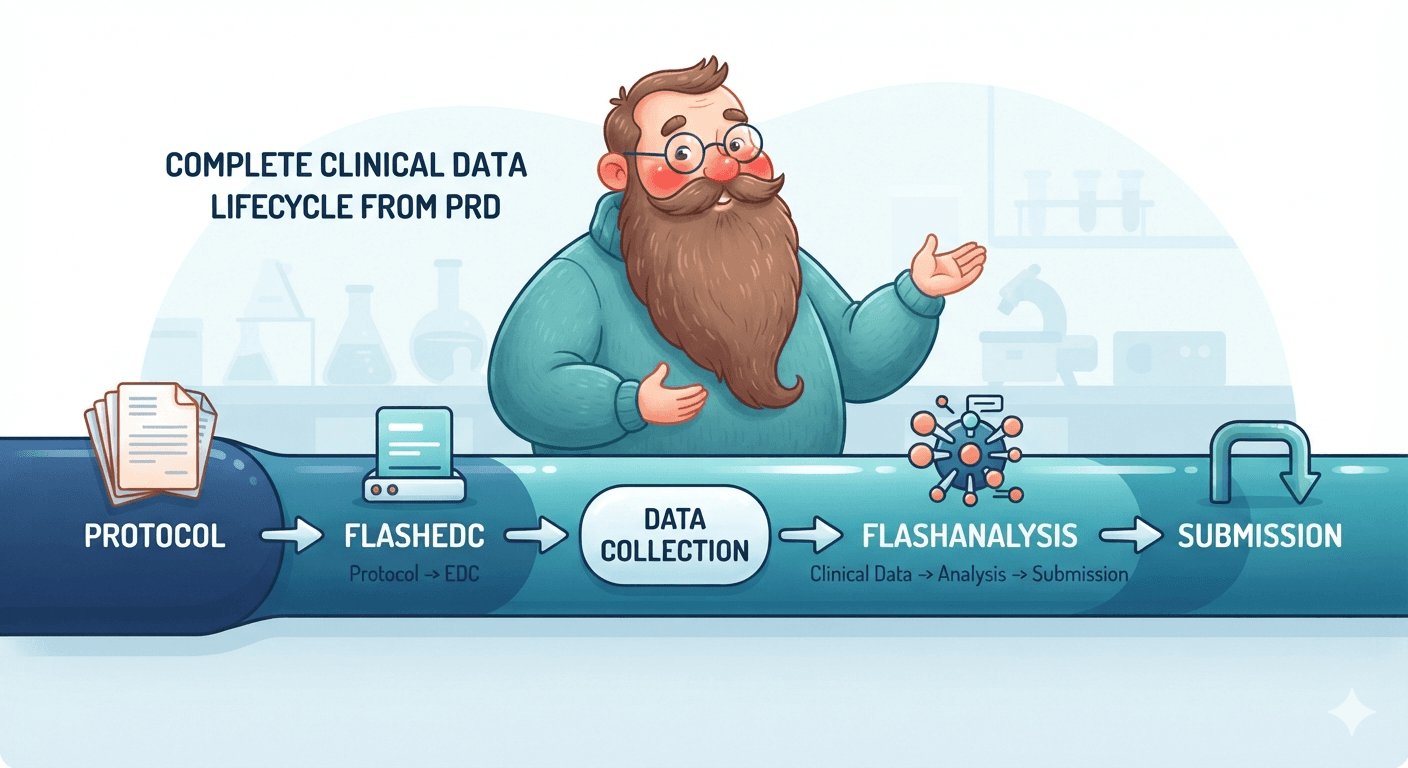
FlashEDC covers the front of the lifecycle: protocol to EDC study design, and the data capture that follows. FlashAnalysis covers everything downstream: clinical data through standards, analysis, QC, and submission.
Illustration of the clinical data lifecycle running from protocol through FlashEDC, data collection, and FlashAnalysis to submission.
Illustration. The full lifecycle the two engines cover: protocol to EDC study design and data capture at the front, data through standards, analysis, QC, and submission at the back.
01Protocol → EDC & Data Capture

FlashEDC

Transform a clinical trial protocol into a structured EDC study design, then capture study data against it.

  • Visit structure
  • Forms & CRFs
  • Fields & controls
  • Code lists
  • Edit checks
  • Generated programming code
  • +6 more
Explore FlashEDC

FlashEDC · Study builder · Protocol SYN-014

Illustrative

Form · Demographics

FieldTypeCode list
BRTHDTCDateISO 8601
SEXRadioCDL_SEX
RACECheckboxCDL_RACE
COUNTRYDropdownCDL_COUNTRY
02Clinical Data → Analysis → Submission

FlashAnalysis

Transform clinical data into standards, analysis-ready datasets, clinical outputs, QC evidence, and submission artifacts.

  • Data intake
  • Provenance governance
  • SDTM
  • ADaM
  • TLFs
  • Independent QC
  • +10 more
Explore FlashAnalysis

FlashAnalysis · Standards pipeline · Study SYN-014

Illustrative

VS · Vital signs

USUBJIDVSTESTCDVSORRESVSSTRESN
1001SYSBP128128
1001DIABP8282
1002SYSBP134134
1002DIABP8686

Interfaces shown are illustrative and built with synthetic values. They are not customer systems, and no study data is reproduced anywhere on this site.

Trust & governance

AI assists. Deterministic systems execute. Humans approve.

Clindaddy is not uncontrolled autonomous AI. Interpretation is separated from execution, production is separated from QC, and approval is an explicit human act.
See how the controls work
  • 01

    Deterministic execution

    AI output is always a reviewable artifact, never a final value

  • 02

    Complete traceability

    Source records and the specifications applied to them

  • 03

    Independent QC

    QC re-implements the computation rather than re-running it

  • 04

    Human in the loop

    Drafts are reviewed before they are built upon

Why Clindaddy

Trustworthy clinical-data automation — not an AI wrapper.

The difference is not that the model is smarter. It is that the model is not the thing producing the clinical numbers.

AI plus deterministic execution

Generative AI assists with interpretation and specifications. Deterministic engines produce clinical outputs.

Human controlled

Users review and approve the decisions that matter.

Independent QC

Production and QC are intentionally separated.

Traceable

Outputs can be connected back to the source data behind them.

One model, many systems

The protocol is read once into a system-neutral study model. FlashEDC and FlashAnalysis are the first two things projected from it — not the only things it is built to project.

Where the technology is today

Working technology with a clear path toward productization.

Clindaddy's products are working technology, not finished commercial SaaS. FlashEDC is in internal use as a CRO tool; FlashAnalysis is a tested, policy-driven platform.
FlashAnalysis~2,500 passing tests
The current FlashAnalysis codebase is covered by approximately 2,500 passing tests, alongside a policy-driven approach to governing real versus synthetic data.
FlashEDCWorking internal CRO tool
FlashEDC is a working internal CRO tool with strong engine fidelity. It currently depends on a specific EDC environment.

Internal engineering metrics describe code health and coverage. They are not evidence of commercial traction, and we do not present them as such.

Next step

Start a conversation about your clinical data workflow.

Tell us where the manual effort sits in your studies. We will show you what the platform does today and what it does not.