
FlashAnalysis · Clinical Data → Analysis → Submission
From Clinical Data to Analysis and Submission.
FlashAnalysis automates downstream clinical programming and standards workflows while enforcing deterministic execution, independent QC, and traceability from every output back to the source record.
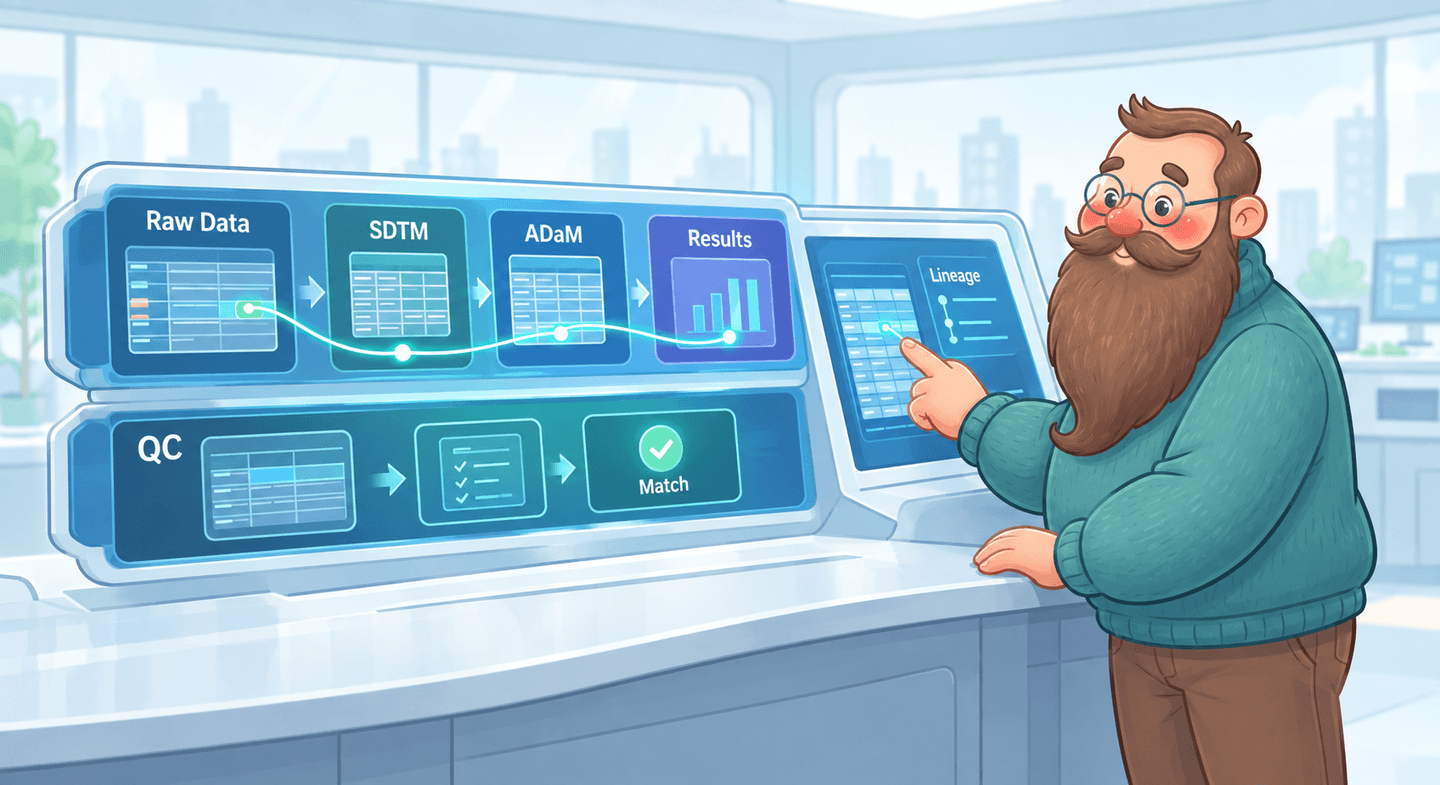
Workflow
What FlashAnalysis does, in order.
Clinical Data
Collected data admitted under a provenance policy.
Provenance Gate
Real and synthetic data handled under explicit policy.
SDTM
Deterministic transformation to CDISC SDTM.
ADaM
Analysis-ready datasets and derivations.
TLFs
Tables, listings, and figures with source traceability.
Independent QC
Independent re-implementation and comparison.
Submission Metadata
Define-XML, aCRF, cSDRG, ADRG, eCTD-lite package.
Audit & Lineage
Append-only audit log; outputs traced to source.
Capabilities
What it produces.
- Data intake
- Provenance governance
- SDTM
- ADaM
- TLFs
- Independent QC
- Cross-artifact QC
- Define-XML
- aCRF
- cSDRG
- ADRG
- eCTD-lite package
- Standards governance
- Reconciliation
- Audit trail
- Data lineage
Data intake
Enforces provenance policies that govern how real and synthetic data may be used, so the origin of a dataset is a first-class property rather than a convention.
SDTM
Transforms clinical data into CDISC SDTM datasets using deterministic processing rather than model-generated values.
ADaM
Creates analysis-ready datasets and the derivations behind them, with each derivation tied to its specification.
TLF generation
Generates tables, listings, and figures with traceability back to the source records that produced each number.
Independent QC
Re-implements the computation independently of production, so QC does not simply reproduce the same implementation and agree with the same defect.
Cross-artifact QC
Checks consistency between datasets, specifications, and outputs — catching the mismatches that per-artifact review misses.
Submission metadata
Generates Define-XML, aCRF, cSDRG, ADRG, and an eCTD-lite package for the submission.
Reconciliation
Compares CRO and vendor deliverables against sponsor outputs and surfaces the differences.
Auditability
Provides append-only audit logging and lineage from any output back to the source records behind it.
Independent QC
A second run of the same code is not a second opinion.
Source data
Collected clinical data
Production
Executes the approved specification
Independent QC
Re-implements the computation
Compare
Differences surfaced, never silently reconciled
Review
A person resolves what the comparison found
Production executes the approved specification. Independent QC re-implements the computation from the same specification by a different route. The comparison between the two results is the evidence — not the fact that both runs finished.
Cross-artifact QC extends that check beyond a single output: datasets, specifications, and the documents that describe them are compared against each other, which catches the inconsistencies that per-artifact review cannot see.
Differences are surfaced for review. They are never reconciled silently, and nothing is released on the assumption that a discrepancy was benign.
Demonstration
See the workflow, step by step.
Evidence is more useful than adjectives. Walk the pipeline each product runs, and the artifact it produces at every stage.
FlashAnalysis · Standards pipeline · Study SYN-014
IllustrativeDatasets
- DMSDTM
- VSSDTM
- AESDTM
- ADSLADaM
- ADAEADaM
VS · Vital signs
QC
Cross-artifact
- ADSL.AGE ↔ spec
- ADAE ↔ ADaM spec
- Define-XML ↔ datasets
Load data
Provenance record attached to each delivered dataset.
Illustrative walkthrough. Datasets, tables, and figures shown are synthetic.
Where it is today
A tested platform with a clear path toward productization.
The current FlashAnalysis codebase is covered by approximately 2,500 passing tests, alongside a policy-driven approach to governing real versus synthetic data.
Passing tests describe code health. They are not evidence of commercial traction, and we do not present them as such.
Next step
See FlashAnalysis against your own protocol or dataset.
Bring a study and we will walk through what the platform produces — and where a human still has to decide.