

Trust & governance
AI assists. Deterministic systems execute. Humans approve.
Clindaddy is not uncontrolled autonomous AI. Interpretation is separated from execution, production is separated from independent QC, and approval is an explicit human act. Everything in between is traceable.
01 · Deterministic execution
The model drafts. The engine executes.
Generative AI assists with interpretation and specification generation — the parts of the work that involve reading and structuring language.
Deterministic engines execute those specifications. The AI does not fabricate final clinical numbers.
The distinction is the point. An interpretation can be reviewed, corrected, and re-run. A number produced by a language model can only be trusted or distrusted.
- AI output is always a reviewable artifact, never a final value
- Deterministic processing is repeatable and produces the same result
- Specifications are the boundary between interpretation and execution
AI → Specification → Deterministic Engine → Clinical Output
- 01AIReads and interprets language.
- 02SpecificationA reviewable, editable artifact.
- 03Deterministic engineExecutes the approved specification.
- 04Clinical outputProduced by defined processing.
02 · Complete traceability
Every output connects back to its source.
Outputs can be traced to the source records, specifications, transformations, and processing steps that produced them.
That chain is what makes a review meaningful: a reviewer can follow a number in a table back to the record and the rule that generated it.
Audit logging is append-only, so the history of a decision is preserved rather than overwritten.
- Source records and the specifications applied to them
- Transformations and processing steps recorded per run
- Lineage from a figure back to the records behind it
Source record → Specification → Transformation → Output
Lineage · one value traced to its record
5 hops
- OutputTable 14.2.1 · Mean SYSBP· Week 12
- DatasetADVS.VSSTRESN· ADaM
- SpecificationADVS-014 derivation· approved
- TransformationSDTM VS → ADVS· processing step
- Source recordVS · USUBJID 1001 · V2· collected value 128
03 · Independent QC
Production and QC are separated on purpose.
Production computation and QC computation are intentionally separated.
The goal is to avoid the failure mode where QC simply reproduces the same implementation and agrees with the same bug — a second run of the same code is not a second opinion.
Independent QC re-implements the computation, then compares results. Cross-artifact QC extends that check across datasets, specifications, and outputs.
- QC re-implements the computation rather than re-running it
- Differences are surfaced for review, not silently reconciled
- Cross-artifact checks cover datasets, specifications, and outputs together
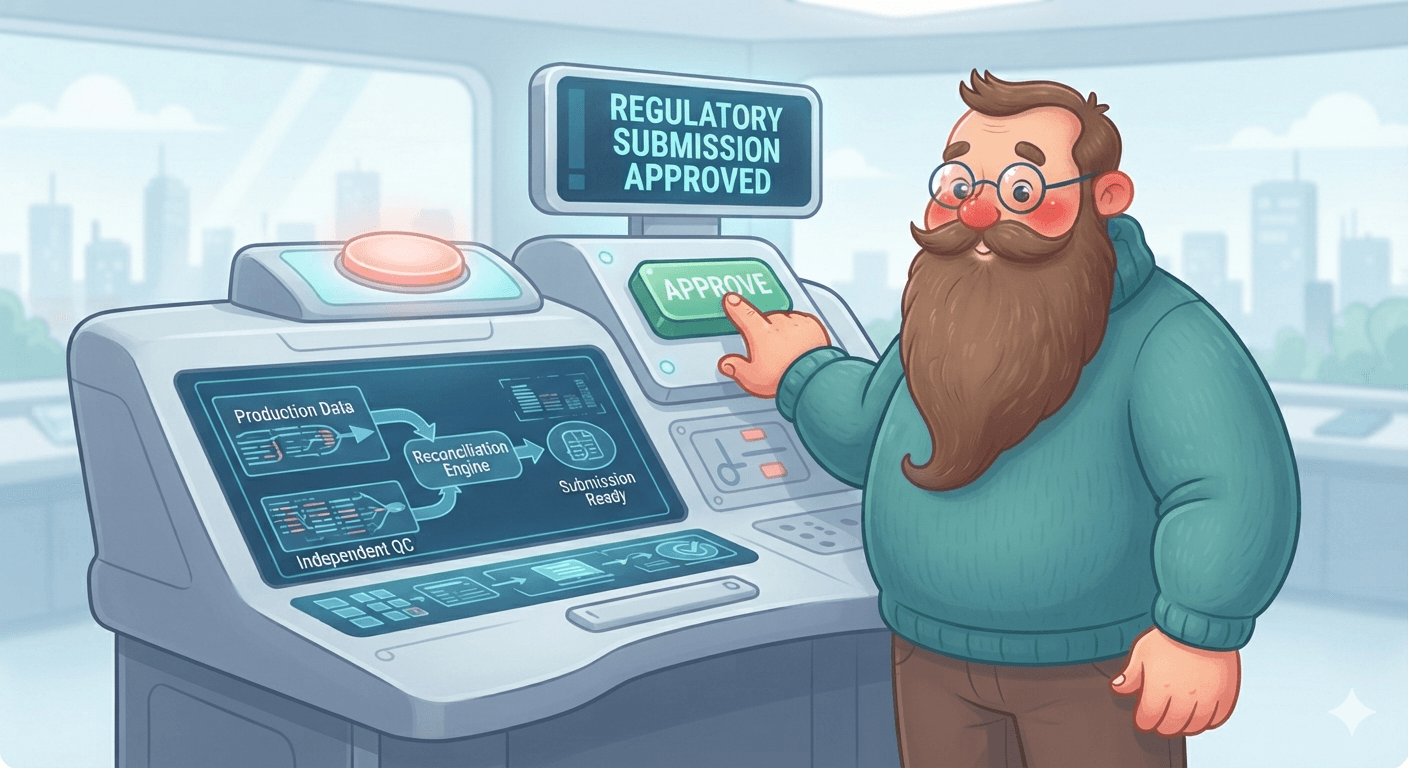
Source data → Production and Independent QC → Compare → Review
Source data
Collected clinical data
Production
Executes the approved specification
Independent QC
Re-implements the computation
Compare
Differences surfaced, never silently reconciled
Review
A person resolves what the comparison found
04 · Human in the loop
Automation should remove mechanical work — not remove accountability.
Generated work is a draft. A person reviews it, corrects it, and the corrected version is what proceeds.
Second-eye QC runs independently of the author, and anything it cannot safely resolve is routed to a human rather than decided automatically.
Approval is an explicit act performed by a named person, not an inferred state.
- Drafts are reviewed before they are built upon
- Corrections are captured in the artifact itself
- Approval is explicit and attributable
AI → Draft → Human review → Correction → Second-eye QC → Approved output
- 01AIDrafts.
- 02DraftA working artifact.
- 03Human reviewA person reads it.
- 04CorrectionJudgement captured in the artifact.
- 05Second-eye QCIndependent adversarial review.
- 06Approved outputSigned off by a named reviewer.
Our commitments
What we will not claim on this website.
A trust page is only worth reading if it also states its limits. These are ours, and they are the reason some sections of this site are deliberately short.
- 01
Working technology with a clear path toward productization.
- 02
AI is presented as enabling technology, not as the product's identity.
- 03
Nothing on this site describes regulatory approval, production deployments, or commercial traction that has not been documented.
Next step
Bring your governance questions to the demo.
Validation approach, audit trails, QC independence, and human approval are fair questions to ask before anything else.