

About
Clinical data work should not be rebuilt by hand for every study.
Clindaddy exists because the same mechanical translation happens at every sponsor and every CRO, on every study, and the effort resets each time a new protocol is approved.
The company
Four questions, answered plainly.
Why Clindaddy exists
Clinical trials still depend on enormous amounts of manual data work. The same study is built, programmed, checked, and documented by hand at every sponsor and every CRO, and the effort resets with each new study.
The problem being solved
The work between an approved protocol and a submission is largely mechanical translation: from protocol to study design, from collected data to standards, from standards to analysis, from analysis to submission artifacts. It is high-volume, high-consequence, and largely repetitive.
Why this approach
Automating that work only helps if the result can be trusted. So AI is confined to interpretation, deterministic engines perform the computation, humans approve the outcome, and the whole path is traceable.
The long-term vision
A single, system-neutral study model, read once from the protocol and projected into the systems a trial runs on — from EDC and data capture through analysis and submission, and eventually into the wider set of systems a CRO operates.
The long view
One canonical study model, spanning the whole lifecycle.
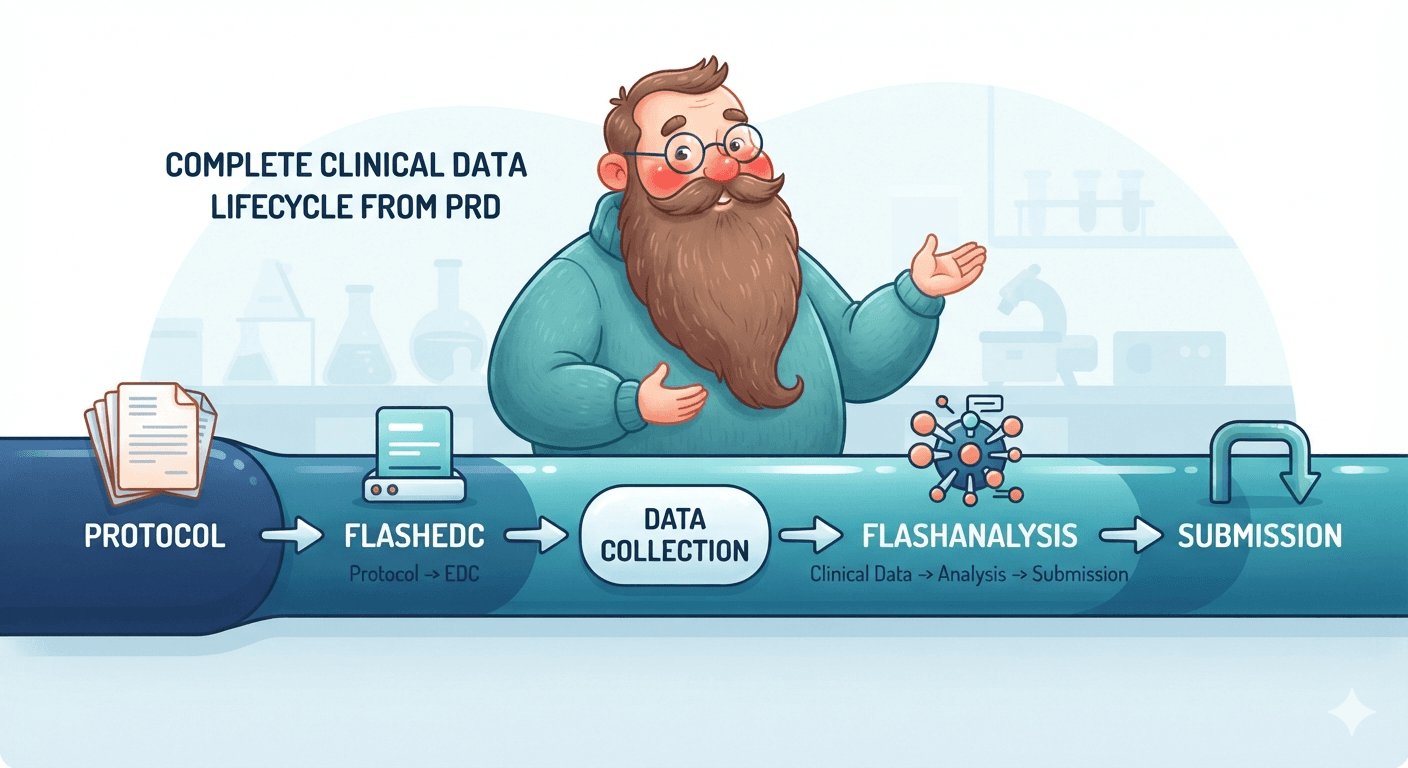
The destination is an AI CRO.
A CRO is paid to do the work of running a trial, with software as its instrument. Software that can produce trial systems from a single protocol read points somewhere further: a CRO whose instrument is that software. That is the destination this architecture points at — not where Clindaddy is today.
Today Clindaddy is a clinical data automation company with two engines. EDC is built; RTSM is in development; the rest of the systems above are architected, not built.
The approach
Four rules, applied to everything we build.
- 01AI assistsInterpretation and specification.
- 02Deterministic engines executeRepeatable processing.
- 03Humans approveExplicit, attributable sign-off.
- 04Everything is traceableOutputs connected to source.
Who is building it
One person today. That is worth stating plainly, because at this stage it is the most useful thing a reader can know.
Bilal Bayindir
FounderMS Computer Science, University of Delaware · 13+ years building EDC software
Thirteen years inside EDC software — the layer studies are built on, not the studies themselves. That distinction is the credential, and it is worth stating precisely: it is knowledge of how a study build is represented, from the object model and codelist architecture through the edit-check specification and identifier derivations. FlashEDC operates entirely at that layer.
The artifact is the credential
The pipeline was designed, built, and run against more than ten real protocols by one person — as development builds, produced to test and improve the tool. No customer has paid for a build, and no trial has run on one.
What is not claimed
No study-delivery history and no management history. Closing that gap is the purpose of the first hire, and it is stated here rather than left for a reader to discover.
Maturity
Working technology with a clear path toward productization.
We are honest about the stage we are at. FlashEDC is in internal CRO use. FlashAnalysis is a tested, policy-driven platform. Neither is presented as mature commercial software, because neither is.
If you are evaluating Clindaddy, that distinction should be part of your assessment — not something you discover later.
Next step
Start a conversation.
Whether you are running studies, evaluating the technology, or looking at the company, we would rather talk than pitch.